
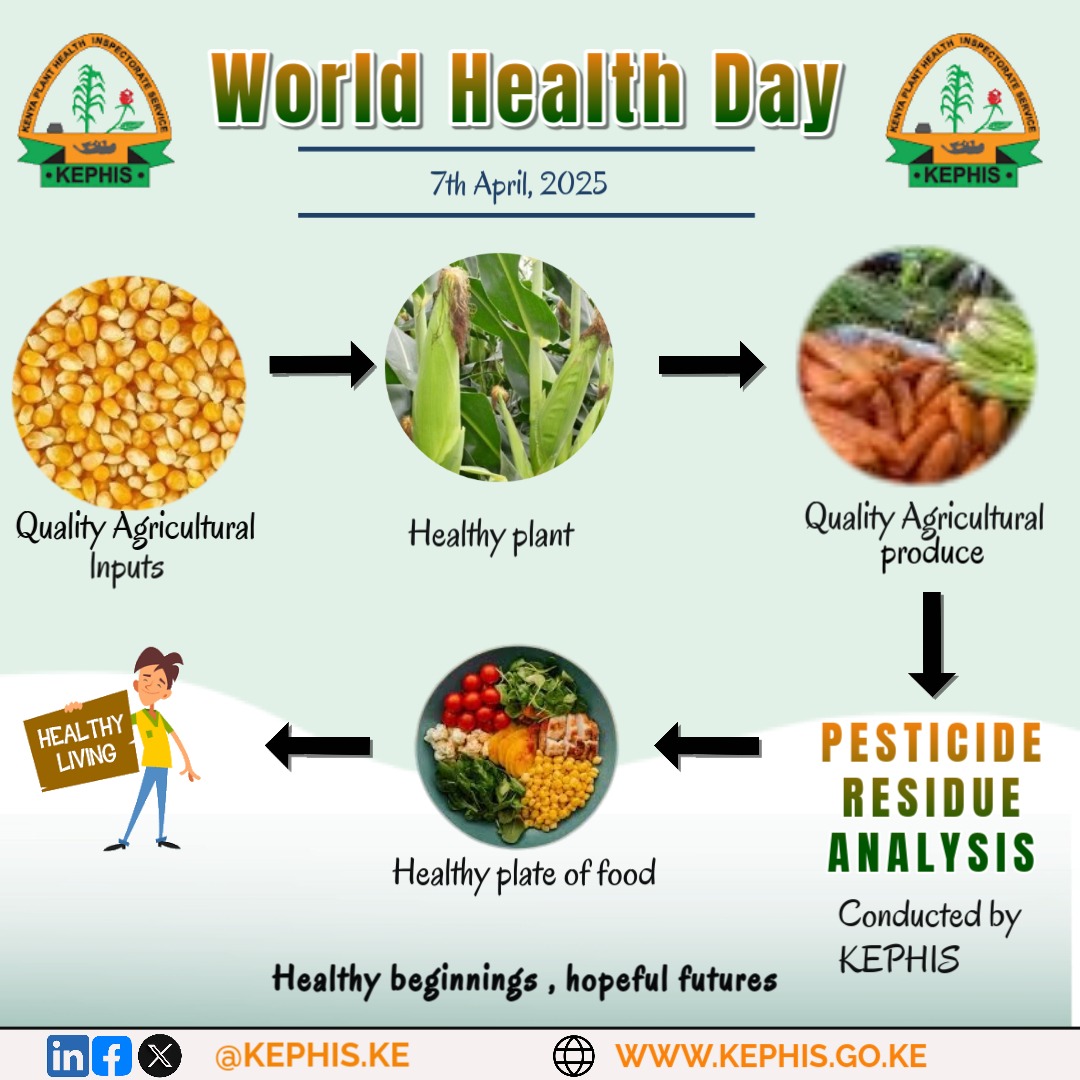
Pesticide Residue Analysis: Safeguarding Food Safety in Kenya
With an estimated 77% of farmers in Kenya relying on chemical pest control, pesticide residue analysis plays a critical role in ensuring that agricultural products comply with both national and international food safety standards, specifically in regards to pesticide residue levels.
To protect the consumers' health, the Codex Alimentarius Commission, a joint initiative of the Food and Agriculture Organization(FAO) and the World Health Organization(WHO), strongly encourages and provides a framework for the harmonization of
food safety regulations. Through this initiative, countries are mandated to take regulatory actions, including setting limits on the amount of pesticide residue permitted in food. These limits are known as Maximum Residue Levels (MRLs). MRLs are determined based on cultivation practices, the toxicity of the pesticide's active ingredient, and national food consumption patterns.
In March 2019, KEPHIS was appointed as the Agent and Public Analyst of the Public Health Department under the Ministry of Health. In this role, KEPHIS is responsible for the analysis, certification, and enforcement of pesticide residue standards for fresh produce sold in the Kenyan market.
Through its ISO-accredited laboratories, the Kenya Plant Health Inspectorate Service (KEPHIS) monitors the presence of toxic residues in agro-inputs, irrigation water, plants, soil, and agricultural produce. This is done through both client-submitted samples and through the National Pesticide Residue Monitoring Program to check for compliance with local and export Maximum Residue Limits (MRLs) requirements.
In addition to pesticide residue analysis, the KEPHIS Analytical Laboratory also provides:
Heavy metal analysis in fresh produce and environmental samples
Aflatoxin testing in cereals, nuts, and pulses
One of the key contributors to high pesticide residues in food is the low adoption of non-chemical pest control methods such as cultural, physical, or biological strategies. To address this, KEPHIS conducts training of stakeholders in the value chain based on the data obtained from the regular surveillance and monitoring programs carried out to determine the levels of pesticide residue in food sold in local markets and supermarkets.
In addition to the regular surveillance and monitoring, KEPHIS also monitors the compliance of imported produce from neighboring countries.
The data generated from these national monitoring programs is disseminated to counties and other stakeholders to guide risk management/intervention options supporting the enforcement of food safety measures in collaboration with the Public Health Department. This makes KEPHIS a key institution in ensuring that Kenyan food is safe for consumption and it is compliant with market standards.
As we mark World Health Day, KEPHIS reaffirms its commitment to food safety. Our goal is to protect the consumer’s health and the environment, ensure compliance with market standards, and promote both local and international trade for a food-secure nation.
A healthy you begins with a healthy plate, free from chemical residues.
KEPHIS remains dedicated to ensuring the quality of agricultural inputs.
Healthy Beginnings and Hopeful Futures.